Artificial intelligence (AI) has rapidly become one of the most transformative forces shaping our world - redefining how we work, learn, connect, and solve problems. At Sheridan, we're not simply reacting to this change. We're helping to define it.
Sheridan's leadership in AI is rooted in a clear vision: that innovation and security must evolve together. We've made it a priority to embed AI across Sheridan's research and innovation ecosystem, known collectively as Generator at Sheridan that includes four renowned research and innovation centres. This ensures that our learners, researchers, and partners are equipped to harness the technology responsibly, ethically, and effectively across disciplines - from creative industries and health care to manufacturing and digital innovation - to drive smarter solutions, enhance productivity, and advance innovation with impact.
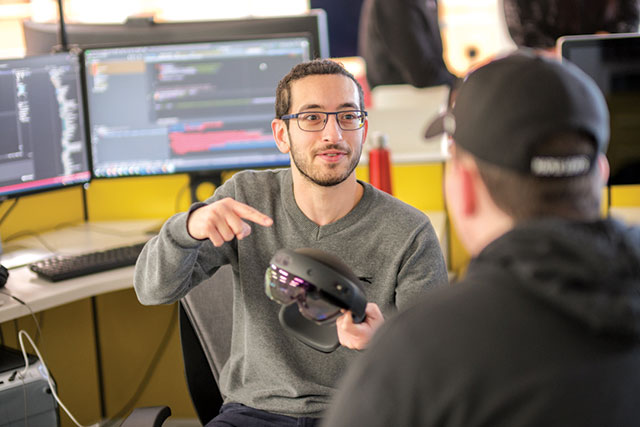 Generator at Sheridan is at the forefront of leveraging AI in research and innovation, empowering faculty, staff, students, and partners to explore industry-driven solutions that also encompass ethical and human-centered considerations. From creative industries to health and advanced manufacturing, Generator integrates AI to drive smarter solutions, enhance productivity and shape the future of applied research.
One research and innovation centre stands out for its exclusive focus on AI and cybersecurity: the Centre for Applied Artificial Intelligence (CAAI). CAAI's mission is clear - to bridge the gap between cutting-edge AI research and the real-world needs of industry, community organizations, and government partners. Unlike most innovation hubs that specialize in either AI or cybersecurity, CAAI unites both disciplines under one roof. This unique blend allows the Centre to focus on secure, scalable AI development - building not only intelligent systems but trustworthy ones.
A defining example is CAAI's collaboration with Korah Inc., a Toronto-based technology company specializing in intelligent automation. Sheridan researchers have developed an AI-driven decision-support application that identifies the most suitable hospitals for transferring critically ill newborns. By analyzing hospital capacity, resource availability, and patient profiles, the tool supports faster, data-informed decision-making - improving outcomes for vulnerable patients and optimizing the use of neonatal intensive care unit resources.
In another collaboration with Encore Market Engagement, a Canadian retail sales and marketing firm, CAAI showcases AI's potential to transform business strategy. Through machine learning models that analyze sales data and identify market trends, the project has generated predictive insights that guide how sales teams are deployed. This data-driven approach has modernized Encore's retail strategies, optimizing performance and helping the company stay ahead of shifting market dynamics.
While CAAI is Sheridan's flagship hub for AI, it's far from the only place where groundbreaking AI research is happening. Across Generator, other research and innovation centres are using AI to push the boundaries of innovation - from prosthetics to virtual humans and neurotechnology.
At the Centre for Intelligent Manufacturing (CIM), AI and robotics are revolutionizing prosthetic design to improve comfort, mobility, and quality of life for lower-limb amputees. Working in collaboration with ProsFit Technologies, an industry leader in prosthetic manufacturing, researchers have developed the Robotic Gait Simulator - a six-axis robotic system that mimics human walking and collects detailed biomechanical data. This system enables prosthetic designs to be tested without human trials, reducing patient burden while increasing precision and efficiency. The insights generated by the simulator will be analyzed using machine learning algorithms to predict how design modifications impact user comfort and energy efficiency. The result is a data-driven, AI-guided approach to prosthetic innovation that supports faster iteration, better customization, and ultimately, devices that feel and perform more naturally.
At the Screen Industries Research and Training (SIRT) Centre, AI is driving breakthroughs at the intersection of neuroscience, immersive media, and digital health. In collaboration with Interaxon Inc., a leading neurotechnology company, researchers have created AI-enhanced digital wellness prototypes that integrate brain-sensing technology and immersive design. These systems use real-time brainwave data to adapt visual and auditory experiences, helping users achieve greater relaxation, focus, and emotional balance.
SIRT has also advanced the use of AI and machine learning in virtual human (VH) animation. Through a national collaboration with postsecondary and industry partners, the M-Body project is transforming how virtual humans are created and animated. By automating complex gestures and movements, AI dramatically reduces animation time while improving realism and responsiveness. The project has produced open-source datasets and advanced animation tools that integrate seamlessly with industry-standard software, giving creators in film, gaming, and virtual reality new ways to bring characters to life. An accompanying ethical AI framework ensures these technologies are developed responsibly, promoting transparency and accountability in generative animation.
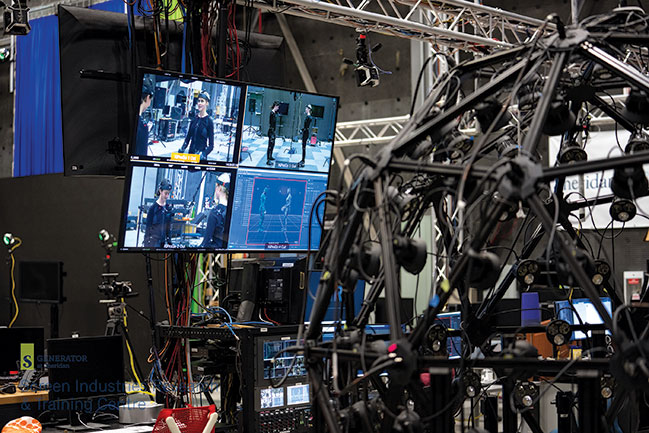 SIRT’s M-Body project setup with advanced tools used for virtual human (VH) animation capture, a project focused on improving the intelligence of VH actions while reducing the time required to convincingly animate VHs through workflows that integrate AI and machine learning.
The Centre for Elder Research (CER) is also advancing the state-of-the-art integration of AI into the growing field of elder care. In partnership with CAAI, and funded by the National Research Council of Canada Industrial Research Assistance Program (NRC-IRAP) CER is also supporting a diverse portfolio of industry partners who are seeking guidance and evaluative support to embed personalized, intelligent recommendation engines to support multiple domains of health, including accessibility, diagnostics, care giving, and socialization.
Each of these projects demonstrates how Sheridan's applied research model translates AI innovation into real-world outcomes. Businesses increasingly understand that while AI can unlock new efficiencies and insights, its success depends on trust, security, and human-centred design. Sheridan provides that bridge - connecting technical advancement with ethical governance, applied experimentation, and rigorous security standards. As industries across Canada accelerate their digital transformation, Sheridan's integrated approach ensures that AI innovation and security evolve hand in hand.
As AI continues to advance at unprecedented speed, Sheridan is committed to staying ahead of the curve - guiding how these technologies are designed, implemented, and governed. The future will demand more than just technical excellence. It will require trust, transparency, and collaboration between academia, industry, and government.
Sheridan's ongoing work in applied AI research ensures that Canada is prepared to meet that challenge. From securing chatbots for military veterans, to enhancing diagnostic tools for clinicians, to helping retailers adapt in real time, Sheridan's contributions are already reshaping industries and improving lives. And this is only the beginning.
As we look to the future, one thing is clear: Sheridan will continue to be a trusted partner and a national leader in advancing a secure, ethical, and forward-looking AI ecosystem - one that serves people first, and ensures that innovation and security evolve together.


 Dr. Vicki Mowat